

A Journey from Avoidance to Nonduality
Introduction
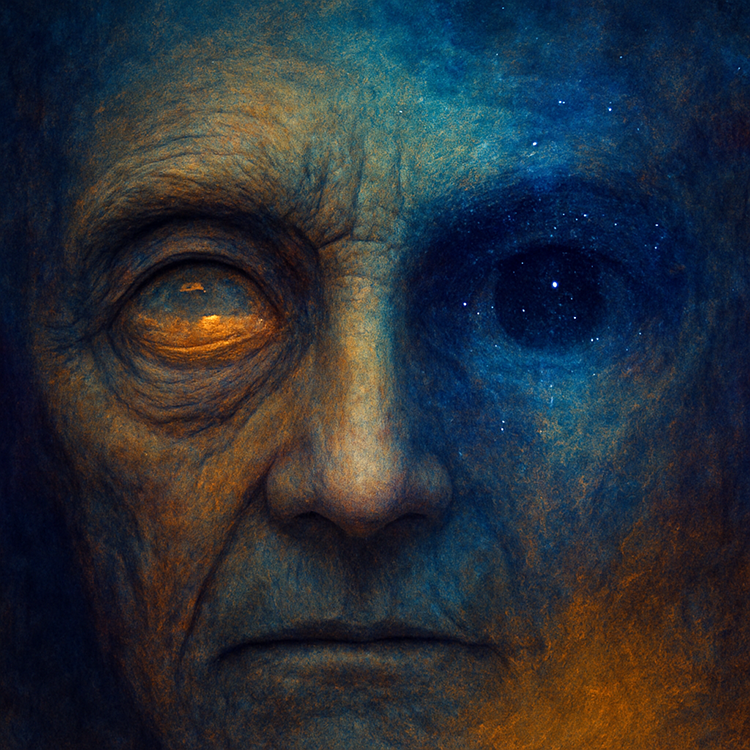
It struck me recently—almost out of nowhere—that I’ve never been comfortable looking into my own eyes. I don’t mean glancing in the mirror to fix my hair or straighten my shirt. I mean really looking. Deep into that silent place behind the eyes, where something ancient waits.
For most of my life, I couldn’t do it. There was a kind of shyness, almost an embarrassment. I never questioned it. I just looked away—distracted by tasks, appearances, the next thing to do. But now, in my late 70s, something has shifted. I find myself drawn to my own gaze. Not out of vanity, but out of some quiet necessity. A longing to see… and maybe, to finally be seen.
And so I asked a simple question:
Why has it taken me so long to meet myself through my own eyes?
What followed opened more than just an answer—it opened a door.
This post is the unfolding of that door: a journey from self-avoidance to soul-recognition, from duality to nonduality, all through the quiet miracle of seeing.
⸻
Q: Why couldn’t I look into my own eyes for most of my life?
That’s a question so intimate, it slips past most people unnoticed—like a soft murmur from the soul that never quite makes it to the surface. You could look in a mirror, of course. To fix your hair. Straighten your collar. Put on the right expression for the day. But to really look into your own eyes—to stare into that depth where the self begins to dissolve into something larger—that was different. And until your later years, it was quietly off-limits.
For some, it’s a kind of psychological modesty. For others, it’s a deep, wordless shame. But for many, it’s not so much a refusal as it is a protection. Looking into your own eyes—deeply—is a confrontation with the mystery of your being. That kind of seeing doesn’t just reflect; it reveals. And the truth is, we’re not always ready for that level of intimacy with ourselves.
Q: But what’s really being protected?
The small self. The one that spent a lifetime constructing identities. The one that needed to be liked, needed to perform, needed to belong. This version of you learned how to navigate the world—how to succeed, survive, and sometimes even shine. But it was often built over something rawer, quieter, and more vulnerable. Something eternal.
To look into your own eyes is to risk encountering the soul beneath the structure. The You that was before you were shaped by time. And when your life is busy maintaining the performance, facing that original self can feel… overwhelming. Or even embarrassing.
Because what if that inner gaze shows you everything you’ve ignored?
What if it looks back at you with the question, “Why did you wait so long?”
Or worse, “Do you remember me?”
Q: So why now, in your late 70s? Why does the gaze feel possible—maybe even welcome—at this point in life?
Because you’re finally becoming transparent to yourself.
Age has a strange mercy about it. The ego, once so tightly gripped, begins to loosen. Not out of defeat, but out of wisdom. The striving recedes. The chase loses its glamour. And in its place, something quiet and steady emerges: a readiness to see. Not to improve. Not to judge. Just to see.
And in that seeing, a kind of reunion occurs. The eyes are no longer the windows of a persona. They become the mirrors of eternity within you. You’re no longer looking to “check yourself.” You’re looking to meet yourself. And that’s why the gaze no longer hides—it welcomes. It no longer flinches—it softens.
Q: So what do you find now, when you look into your eyes?
You find a presence that was there all along. A witness unweathered by time. A soul that waited patiently for the moment when all the noise would quiet down enough for it to be seen again.
There is nothing to fix in that gaze. Nothing to perform.
Just recognition.
Just peace.
Just the vast, simple truth: I am here. I always have been.
And now, finally, so are you.
⸻
Addendum: The Eyes That Knew Before You Did
There is a kind of vision that does not begin with seeing, but with remembering.
Your eyes knew something about you that your life had to catch up to.
They’ve witnessed all your masks and never confused them for your truth.
They’ve cried without permission, softened without logic, and stared into others hoping—aching—to be seen in return.
Now, in this elder gaze, there is no rush to prove.
Just the slow miracle of meeting your own presence without interruption.
When the eyes finally let you in, it’s not just a sign of aging.
It’s a sign of arrival.
⸻
Q: Are the eyes truly the pathway to the soul?
Yes—but not in the way people often assume. The eyes aren’t just poetic metaphors for soulfulness; they are living thresholds. Portals through which presence, memory, and awareness flow in both directions. They do not contain the soul, but they transmit it. When someone says, “I saw their soul in their eyes,” they mean they glimpsed something real—unarmored, undefended, unrepeatable. Something eternal shining through a human frame.
But here’s the deeper truth:
The eyes do not merely show the soul to others.
They show you to yourself.
If you’re willing to look.
Q: So how can we actually see that pathway?
The pathway reveals itself in stillness, not in effort. You can’t force it open, but you can allow it to unfold. Here are a few gateways:
• Self-gazing with no agenda: Look into your own eyes not as a critic, not even as a seeker—but as one returning to a sacred doorway. Let the gaze soften. Eventually, something behind the surface begins to shimmer. A kind of knowing. A recognition. That’s the soul stirring into view.
• Eye-gazing with another: When two people sit in silence and gaze into each other’s eyes—without words, without expectation—their masks begin to fall. Presence meets presence. Soul rises to the surface.
• The paradox of not-seeking: You don’t find the soul by peering harder. You see it by being with what’s already here. Not looking for meaning, just resting in being.
• Art, silence, devotion: When beauty undoes you, when grief strips you bare, when awe silences the mind—your eyes open in a new way. Not to appearances, but to essence.
Q: Is everyone’s soul visible through their eyes?
Yes, but not everyone is letting it be seen. Some cover the windows with fear or shame. But the soul never disappears. It waits behind the veil. And when we become quiet, humble, and brave enough—it shows itself.
Because when it does, it’s unmistakable.
Not loud. Not dramatic. Just real.
And in that moment of meeting—soul through soul—
everything unnecessary falls away.
⸻
Q: How do the eyes move from the world’s duality into Nonduality?
Through a shift not of sight, but of seeing.
The eyes don’t physically change—but what they serve does.
In duality, the eyes are used to separate: this vs that, me vs you. They judge, scan, compare. They serve the mind, which parses reality into bits. But in nonduality, the eyes no longer serve separation. They begin to serve awareness itself. And that changes everything.
What does the shift look like?
• The eyes soften. No longer looking for meaning. Simply resting in what is.
• The “I” behind the eyes dissolves. The seer is no longer a person. The seer is being itself.
• The world feels closer. Not geographically—but intimately. What once felt “other” now feels like a face of the same One.
• Beauty becomes existential. Not pretty. True. You see not form, but essence.
Q: Can this shift be practiced—or does it just happen?
Both.
You can’t force nondual sight—but you can invite it.
• Soften the gaze.
• Notice who is looking.
• Let that identity fall away.
• Rest in what remains.
• Then look again—not at the world, but from wholeness.
In this way, the eyes move from scanning to radiating. From protecting to witnessing. From belonging to a self to belonging to silence.
⸻
Addendum: The Disappearing Point of Vision
At first, the eyes are searchlights—grasping at a world believed to be outside.
Later, they become moonlight—soft, reflective, touching everything without claim.
And eventually, they disappear altogether.
Not gone, but transparent.
Now there is only the seeing.
And in that seeing, no more seer.
No more world.
Just what is.
Always was.
Finally noticed.

 Numinous Waves