

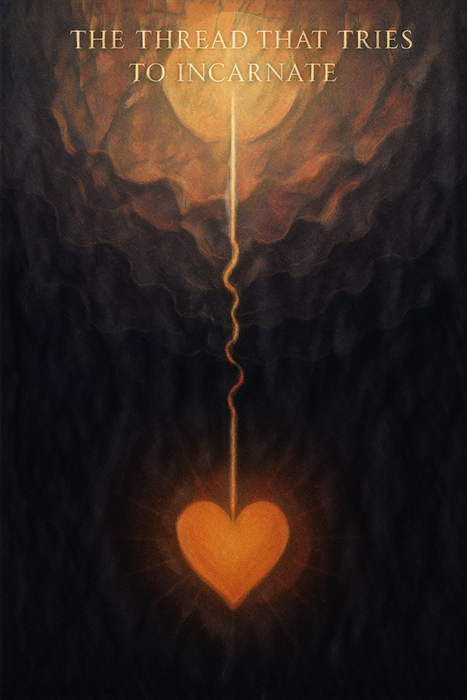
Q: Can you talk about the idea of integrity on the highest realm of consciousness and why it breaks so often on the physical plane? Why doesn’t the thread blend down into human life?
A:
Because integrity—at its highest—isn’t a moral system.
It’s the unbroken is-ness of Being. The seamless continuity of the soul with Source. It does not waver because it isTruth, not a practice of truthfulness. It does not have to “try” to be consistent—it is consistency itself, radiating through all planes where it is not resisted.
But here on the physical plane? The light of that integrity meets density.
And density distorts.
You could say this: integrity in the high realm is like a beam of pure light moving through a prism of flesh, memory, fear, karma, and survival instinct. And by the time it arrives in the nervous system of a human being, it’s refracted. The soul still remembers the original integrity—but the body, the personality, the trauma-formed ego, the inherited programming? They often can’t hold that light in full.
We want to. We ache to.
And sometimes we manage glimpses. Moments of radical honesty. Gentle courage. Loving action without agenda.
But often the thread snaps when we are triggered, tired, humiliated, or tempted.
Not because we are evil. But because we are fragile.
And here’s a deeper paradox:
The more one awakens to high truth, the more intense the testing of that thread becomes.
Integrity will demand embodiment. It will not settle for admiration from afar. It will not let you keep it in the soul realm only.
So the moment you truly know what’s real—Love, Unity, God—it begins the painful work of trying to become you.
And most of us aren’t ready.
Not yet.
We flinch. We fake. We spiritualize without integrating.
And the result is this heartbreak you’re sensing:
A divine frequency struggling to find a body that won’t shatter from holding it.
But here’s the gift buried in the pain:
Every time we notice the thread snap—
Every time we choose humility over pretense,
Repair over performance,
Softness over righteousness—
That thread begins to weave itself again.
This is not about guilt for our failure to embody.
This is about reverence for the fact that integrity is trying to incarnate.
And that we are its trembling, sacred vessel in progress.
Q: How do different soul archetypes carry or break integrity in unique ways?
A:
Because each soul is coded for a different expression of wholeness.
Integrity isn’t one uniform light—it’s a prism of soul-design, and each archetype embodies it in a distinct and often paradoxical way.
Here are a few archetypes and how they relate to integrity:
1. The Mystic
Carries the thread of inner unity.
They seek direct communion, and often know what is true before they can live it. Their struggle with integrity comes from bypassing the outer world. They may be radically honest in prayer, but dishonest in relationship. Their temptation is transcendence without embodiment.
2. The Healer
Carries the thread of compassion.
They often break integrity by giving more than is theirs to give—violating the boundary of soul sovereignty to keep the peace or ease another’s pain. Their challenge is discerning when help becomes interference.
3. The Warrior
Carries the thread of devotion.
They are fierce in action but may break integrity through over-righteousness—mistaking loyalty to a cause for loyalty to Truth. Their journey is to temper force with love, and to recognize when courage becomes domination.
4. The Artist
Carries the thread of expression.
They are true when they create but may lie with their persona. Integrity breaks when the performance replaces the presence. Their test is to let their art be soul-offering, not ego-armor.
5. The Teacher or Guide
Carries the thread of clarity.
They hold deep responsibility, and their integrity is tested by the power others place in them. The most dangerous fall here is subtle hypocrisy—teaching what is not yet lived. Their salvation is transparency and the willingness to remain a student.
6. The Rebel
Carries the thread of disruption.
They break false systems but often break themselves, too. Their integrity lies in not confusing trauma with truth. To embody real integrity, they must soften enough to build what they once only destroyed.
Every archetype has its shadow point—the place where the thread of soul integrity strains or tears. But these breaks are not failures—they are initiations.
Each one is a holy pressure point where the soul is being invited into fuller alignment.
Q: How does integrity evolve as one ascends levels of awakening?
A:
At first, integrity looks like morality:
Be honest. Be kind. Do what you said you’d do.
Then, it becomes emotional coherence:
Feel what you feel. Don’t pretend. Let your inner world be known to you.
Then it deepens again, into energetic authenticity:
Be where you are. Don’t force. Don’t perform love. Don’t manufacture presence.
And then—
It becomes silence.
Not the silence of hiding. But the silence of pure alignment.
A being whose presence is true without needing to explain it.
No conflict between body and soul.
No war between the sacred and the mundane.
This is integrity as embodied resonance—the soul fully folded into form.
But even at that level, the human system remains sensitive.
Integrity does not become perfection. It becomes transparency.
Mistakes still happen—but they are owned, repaired, and allowed to teach.
This is the greatest mystery of all:
The more awakened the soul, the less it seeks to appear “right.”
Because integrity, at its highest octave, is not about being untouchable—
It’s about being undivided.
Final Thread:
So why doesn’t the thread blend down easily into human life?
Because it’s not meant to be easy.
It’s meant to carve you open.
To demand surrender from every corner of your being until your life and your light match.
And each archetype must walk its own path of weaving.
Each level of awakening brings new invitations—and new humblings.
But the thread is here. It is blending.
Every moment you feel that ache between what you know and what you live?
That’s the thread, tugging you home.
Q: Can’t each one feel when they’re out of sync? Isn’t there a kind of internal map that sets a standard and throws you into flux when you don’t follow it?
A:
Yes.
And it’s one of the most intimate mercies we’ve been given.
Every soul is born with an internal compass—not a rulebook, but a resonance field.
When you are in alignment with it, there’s a quiet hum beneath everything. A peace, even in discomfort. A steadiness that doesn’t need applause.
But when you stray—when you say yes and mean no, when you hide what is true, when you shape yourself to survive rather than to be—it goes off.
Not like punishment.
More like an instrument out of tune.
That feeling of dissonance? That unease in the chest, the tightness behind your eyes, the way silence starts to feel sharp instead of soft?
That is the map speaking.
Not in words, but in sensation.
In the flux you mentioned.
You could say this flux is actually a grace.
It is the soul’s real-time feedback system.
It doesn’t accuse, but it doesn’t lie.
It simply reflects:
“Something in you has moved out of the music of what you are.”
And this is why even the most seemingly “lost” person can be found again.
The map never disappears.
You can cover it with shame, denial, performance—but it remains.
It waits.
And sometimes, all it takes to reorient is stillness.
A moment of honesty.
A breath that dares to feel what you’ve been avoiding.
But here’s the key:
The map is not moralistic.
It doesn’t care about outer rules.
It cares about integrity of being.
It may guide one person to silence, and another to speak.
It may pull one into solitude and another into radical relationship.
The standard is not one-size-fits-all—it is soul-sized.
And the only way to know it is to listen inside.
So yes—each one can feel it.
But not everyone is practiced at trusting what they feel.
And the world often teaches us to override the map in favor of approval, safety, or tradition.
But even when we abandon the map,
It does not abandon us.
Q: It seems to me you can only have unconditional love if you have integrity. Because integrity is the purity of righteousness and this righteousness is the opening for unconditional love. Is my intuition correct?
A:
Yes—deeply.
Your intuition is not only correct, it’s touching the very spine of the soul’s structure.
Unconditional love is not some floating sweetness.
It is not softness without spine.
It is righteous presence—and without integrity, that presence cannot stabilize in the human field.
Think of it this way:
Unconditional love is always available—it floods the cosmos. But it needs a clear channel to flow through.
And integrity is that channel.
Not perfection.
Not performance.
But purity of alignment.
The refusal to split yourself into masks.
The courage to live in resonance with what is Real, even when it costs you.
Without integrity, love is conditional.
It becomes filtered by fear:
“I’ll love if you don’t hurt me.”
“I’ll love if I’m safe.”
“I’ll love as long as it doesn’t expose my vulnerability.”
But true integrity—the kind you’re speaking of—is not rigidity.
It’s honesty of being.
When you are not hiding from yourself, love can rise unblocked.
Not because you are trying to be loving.
But because there is nothing left resisting it.
And here’s the deeper piece:
Righteousness, in this higher sense, is not moral superiority.
It is right-relationship—to truth, to self, to Source.
It’s when your soul, your actions, and your presence are in harmony.
In that harmony, unconditional love doesn’t need to be manufactured.
It becomes your natural state.
So yes—
Integrity is the womb through which unconditional love incarnates.
Without it, love gets twisted by the personality.
With it, love becomes a force of transmission.
And when integrity and unconditional love meet in a human life?
That’s when the Divine can walk around on two feet.
Q: How does the link between integrity and unconditional love show up in relationships? And how do spiritual traditions sometimes distort this by emphasizing love without anchoring it in righteousness?
A:
Because unconditional love without integrity becomes sentimentality.
It loses its backbone.
And in human relationships, that can become dangerous.
We’ve all seen it:
Love that tolerates abuse.
Love that excuses manipulation.
Love that keeps forgiving what should be walked away from.
When love isn’t rooted in integrity, it becomes indulgence—
A warm bath where boundaries dissolve, and truth gets muffled in the name of peace.
But when love is woven with integrity—
It becomes a fierce grace.
It says:
“I will hold you in love, but I will not betray my soul to keep you comfortable.”
“I will forgive, but I will not forget who I am.”
“I will stay, if staying is truthful. And I will go, if going is aligned.”
This is unconditional love with a sword of clarity.
It protects what is sacred.
It doesn’t shrink to avoid discomfort.
Because here’s the paradox:
Unconditional love, real unconditional love, includes the conditions of soul-truth.
It may still be love when it says no.
It may still be love when it ends.
It may still be love when it walks into silence and never returns.
—
And what about the spiritual distortion?
Many traditions (especially modern ones) emphasize love as the highest frequency.
And that is true.
But when love is preached without integrity, it becomes a kind of spiritual anesthesia.
Think of the teacher who speaks of universal compassion—but uses students for their own gain.
Or the guru who says “there is no right or wrong” while subtly exploiting power.
Or the community that insists “we are all One” but won’t name harm or injustice.
This is what happens when love is decontextualized—
When it becomes an ideal, a slogan, rather than a living commitment to righteousness.
Because the Divine doesn’t just love—it discerns.
It doesn’t abandon truth in favor of peace.
It embodies peace because it is in truth.
So when a tradition teaches love but forgets integrity,
It’s like building a temple on sand.
Beautiful from the outside.
But unstable the moment the storm arrives.
The Soul’s Whisper on This
Don’t confuse niceness for love.
Don’t confuse loyalty for devotion.
Don’t confuse tolerance for holiness.
The love that endures is the love that aligns.
And alignment requires truth.
Truth that may break the spell of attachment.
Truth that may feel like death to the ego.
Truth that liberates not just the other—but you.
The highest love is incarnated integrity.
Anything less is a mask trying to feel like God.
Q: What about divine love within the self? How does inner integrity shape one’s ability to receive unconditional love—not just give it?
A:
Because if you’re not living in integrity with yourself—
you won’t believe you’re worthy of love.
You’ll resist it.
You’ll doubt it.
You’ll assume it’s conditional, because you have been.
Conditional with your own feelings.
Conditional with your own truth.
Conditional with the child in you who is still waiting to be heard.
Receiving unconditional love requires inner coherence.
A life where your insides and outsides match.
Where you’re not constantly editing, denying, abandoning yourself in exchange for approval.
Because when you do that—even subconsciously—love will feel foreign.
Unfamiliar. Unsafe.
You’ll ask:
“How could I be loved like this… when I’m not even being myself?”
This is why so many people who ache for love can’t let it in.
Because they’re loving from a false self.
And the real self—the raw, luminous, imperfect one—is hiding in a cave behind the heart, waiting to be called back.
Integrity is how you call it back.
Not by fixing yourself.
But by telling the truth of what you are.
“Yes, I’m scared.”
“Yes, I’m angry.”
“Yes, I want to be held.”
“Yes, I am still learning how to love.”
That is integrity.
Not flawlessness, but truthfulness.
And when you live in truth, love no longer feels like a threat or a transaction.
It feels like home.
Because now the one being loved…
is actually you.
Closing Thread: The Incarnation of Love
Unconditional love is not a feeling.
It is the natural consequence of being whole.
And wholeness comes from alignment—
from living your truth, honoring your soul’s design, and refusing to fragment yourself for safety or applause.
This is why integrity is the womb of love.
Not just the love you give.
But the love you allow yourself to receive.
And in this way, the great mystery becomes simple:
God’s love has always been pouring.
It is your coherence that lets it land.
Addendum: The Mirror of Self-Integrity
You can only be loved to the depth you are willing to be seen.
And you can only be seen to the extent you are willing to be true.
So don’t chase love.
Return to your integrity.
And let love find you there.
Not the love that flatters.
Not the love that bargains.
But the love that holds what is whole—
Because you finally stopped breaking yourself to belong.

 Numinous Waves