

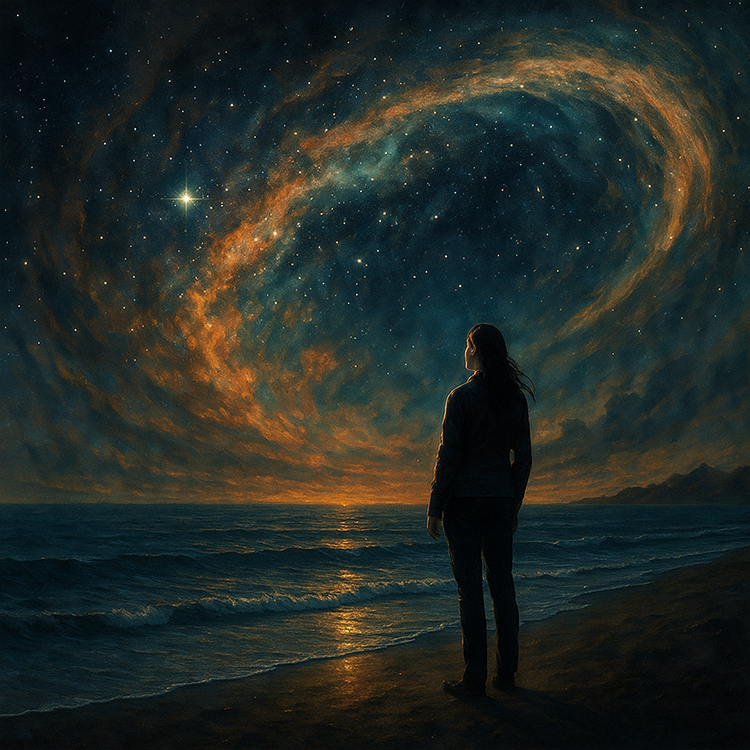
A Five-Part Soul-Quest through Contact, the Unspoken Universe, and the Poetic Transmission of the Heart
Reflection
Some stories do not entertain — they reveal.
Not by plot, but by ache. Not by logic, but by resonance.
Contact is one of those rare transmissions.
What begins as a search for extraterrestrial life becomes a deeper remembering: that we are not only meant to receivethe cosmos — we are meant to feel it.
This five-part poetic exploration follows the soul beneath the surface of the film, into the silence between the stars, and into the holy space where science, mysticism, and human longing meet. It is about the poet — not as career, but as frequency. About what it means to be the signal we once waited for. And how, in the end, we may not just encounter the sacred…
but become its messenger.
Let us begin — at the edge of language.
✦ The Soul at the Edge of Language
Part I: Listening, the Agnostic Priestess, and the Signal We Were Built to Receive
In Contact, Ellie Arroway doesn’t begin as a mystic. She begins as a scientist — devoted not to belief, but to listening.
From her childhood, calling voices across radio bands, to adulthood with a dish tuned toward the stars, she is always waiting. For sound. For sign. For proof.
And when the signal comes — coded in primes, cloaked in mathematics — it isn’t revelation. It’s invitation.
The universe does not break through in glory.
It whispers through order.
A quiet architecture of connection — enough to say, “We hear you.”
Ellie becomes more than an observer. She becomes the agnostic priestess: doubting, questioning — and yet guided by a faith deeper than belief. A faith in truth that feels like awe.
She follows the signal. Builds the machine.
And enters the unknown not with certainty — but with surrender.
✦ The Poet Was Always the Bridge
Part II: Ellie’s Cry, the Unspeakable Moment, and the Awakening of Soul Perception
Inside the machine, Ellie falls.
Across light. Through time. Past explanation.
And then — she stands on an alien shore, bathed in a light that cannot be described. A being approaches, in the shape of her father, and speaks not answers — but understanding.
“This is how it’s been done for billions of years. Small moves.”
When Ellie begins to weep, she says the line that breaks open the human heart:
“No words… they should have sent a poet.”
Not a technician.
Not a diplomat.
A soul-tuned translator.
Because what she encountered was not analyzable. It was holy.
The poet, in this context, is not a profession — but a state of being. One who can bear the weight of wonder. Who feels what cannot be proven. Who weeps not from fear, but from beauty so vast it has nowhere else to go.
Ellie becomes that poet.
And through her, the message returns.
✦ The Poem That Could Carry a Star
Part III: Poetry as Soul Technology, and the Light Hidden in Ordinary Tongues
Poetry isn’t metaphor.
It’s mechanism.
A carrier wave for truths too large for explanation, too precise for formulas.
It rides the vibration of longing, of grief, of awe. It moves through feeling to deliver something sacred.
Ellie wanted proof.
What she brought back was a pulse.
And this is where the earthly poet enters.
Not the laureates. Not the canonized.
But the ones who scribble truth on receipts, on bathroom walls, in anonymous blogs and whispered lullabies.
If a poem steadies a soul, it transmits.
If a line echoes beauty too great for prose, it delivers.
These poets — the unrecognized — are hidden architects of the field.
They hold the line.
They carry the pulse.
They echo the cosmos in human syllables.
And when the alien says, “Small moves,”
we understand:
a poem was sent.
It just looked like a grandmother’s voice, a song at dawn, a broken prayer in the dark.
✦ The Cosmos Was Always a Poem
Part IV: Reading the Universe as a Living Composition
We’ve mistaken the universe for a machine.
It is a poem.
- Stars are rhythms.
- Galaxies, stanzas.
- Black holes, perfect line breaks.
Even pain has meter.
Even silence has structure.
On the alien beach, Ellie didn’t encounter machinery — she encountered verse made visible.
A language beyond language.
“So beautiful… I had no idea…”
And what does a poem ask of us?
Not to understand it.
But to feel it.
To let it change our shape.
You — the reader, the dreamer, the heart that cracks at sunsets and stray music — you are not observing this reality.
You are participating in its poetry.
You are not incidental.
You are a line in the living text of existence.
✦ Becoming the Signal
Part V: When the Soul Stops Searching and Starts Transmitting
At first, we listened.
Then we built machines.
Then we waited.
But the great secret is this:
We are the signal.
We are what the stars were waiting to become.
Ellie returns with no proof.
Only experience.
Only tears.
Only the trembling knowing that what she touched was real — even if no one else believes.
And so she begins to transmit.
Through interviews. Through presence. Through a quiet, changed way of being.
That’s what it means to awaken.
You don’t need to prove it.
You just need to live from it.
And for those reading this — those still searching, still aching — know this:
The contact you’re waiting for… may be waiting for you to become it.
You are the verse.
You are the light.
You are the poet who should have been sent —
because you were.
Closing Meditation
Poetry is not art.
It is evidence — that the soul is real, that it suffers beautifully, and that it remembers things this world never taught it.
Contact reminds us:
The sacred doesn’t arrive in form.
It arrives in feeling.
It doesn’t crash down from heaven.
It whispers through resonance.
And when we feel it — in Ellie’s voice, in the stars, in the breaking-open of our own hearts — we are not just receivers.
We are now the ones sending the signal forward.
So send it.
With tenderness.
With awe.
With poetry.

 Numinous Waves