

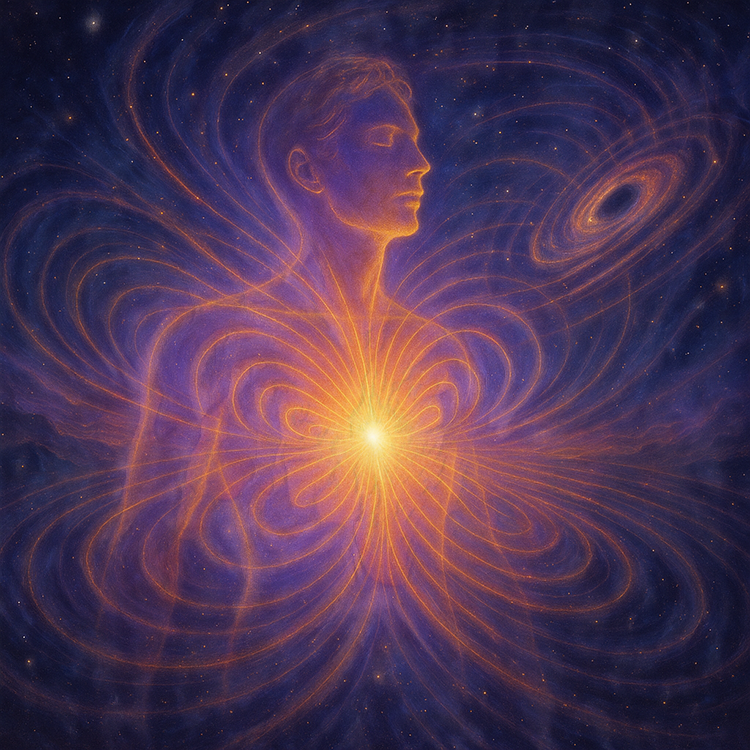
A Numinous Waves Quest Through the Myth of Interstellar, the Wave of Reality, and the Love That Builds the Universe
There are stories that rise from the human mind — and there are stories that descend through it, carrying the pulse of a higher realm. This journey through Interstellar is more than a meditation on film — it is a passage into the imaginative stream flowing from the Creative Realm of Consciousness beyond time, where myth and physics, soul and science, converge. What we call fiction may, in truth, be a dimensional remembering — a sacred architecture encoded in symbol, arriving just ahead of awakening. Imagination, when surrendered to the Infinite, becomes more than vision. It becomes a living map across the veil, charting both what we are destined to build… and what we are finally ready to reclaim.
Part I: The Cradle and the Stars
We begin in a dust-choked world, dry and forgetful. The sky no longer stirs wonder, only warning. Generations have collapsed into survival. Imagination has been outlawed by pragmatism. The soul has gone quiet, buried beneath cornfields and false memories.
And yet — one man remembers to look up.
Cooper, a father, a pilot, an exile of purpose, hears the whisper of something more. Not with words. With gravity. With symbols written into the patterns of dust on a child’s bedroom floor.
This is how all soul-quests begin:
Not with lightning — but with a shimmer. A knowing that doesn’t belong to the mind.
And so we follow him — not just through Saturn’s orbit and the wormhole beyond, but through the curvature of our own forgotten longing. Because this story isn’t only Cooper’s. It’s ours.
A world dying.
A path opening.
A choice: to stay safe… or to go.
Part II: The Wormhole is the Soul’s Leap
Near Saturn, a tear in space waits.
It did not form by accident. It was placed — by intelligences evolved beyond time, beyond form. They reach back to us not to save us, but to invite us to evolve. To remember.
The wormhole isn’t just a scientific anomaly. It is the threshold moment — the sacred gate each soul must face.
Not a door we walk through lightly.
But the kind that demands faith.
That insists on surrender.
In spiritual terms, this is the Dark Night’s turning point. The moment we let go of Earth — of identity, memory, and control — and offer ourselves to the unknown.
Through it, Cooper emerges into a system of strange suns, distorted time, and oceans that rise like mountains. But time here has teeth.
Miller’s planet shows us what happens when we hover too close to massive gravity: time slips away. One hour = seven years. And every soul feels this, don’t they? That ache… that we’re running out of time. That we missed something while chasing survival.
Part III: Dr. Mann and the Seduction of Fear
Not all travelers seek truth.
When we meet Dr. Mann, humanity’s most “brilliant” astronaut, we find the shadow-self — the aspect that fears death more than it trusts life. Mann is intellect without soul. Knowledge without wisdom. He embodies what happens when we claim the heroic mantle without inner transformation.
Mann lies. Fakes data. Risks lives. Because ego must win — even if truth dies in the process.
He warns Cooper with one of the film’s coldest lines:
“Don’t judge me, Cooper. You were never tested like I was.”
But that is the test:
Not to survive.
But to love under pressure.
Mann dies trying to dock, screaming triumphantly — and exploding in silence.
A warning to all who ascend without shedding the self.
Part IV: The Event Horizon of the Soul
It comes to this: a black hole called Gargantua.
A name that means glutton — a devourer of time, of light, of certainty. And yet it is into this abyss that Cooper willingly falls.
Why?
Because he trusts love more than reason.
Because he knows the mission — the real mission — was always his daughter.
This descent is not a suicide.
It is an initiation.
Spiritual traditions have called this moment by many names:
- The Void
- The Night Sea Journey
- The Cave of Regeneration
It is not death. It is unbecoming.
In that place where light curves and time loops, Cooper enters a tesseract — a multidimensional construct built by “them” — future humanity. But really, it’s the soul’s library, the Akashic field woven into the geometry of a child’s bedroom bookshelf.
He does not communicate with words, but with gravity — love’s fingerprint in spacetime.
The very force that drew him into the story — now flows through him.
He becomes the ghost his daughter once feared.
He becomes the answer he once sought.
Part V: Murph — The Awakening of the Divine Mind
Back on Earth, Murph, no longer a child, has become a myth-breaker.
She is intuition armed with science. The sacred feminine remembering the code. And she does what the entire mission was meant to do: solve gravity. Not through logic alone, but by trusting the whisper of love — the anomaly her father once left behind.
Murph is more than a character. She is Sophia — the divine wisdom born from human grief and eternal connection.
When she says, “Eureka,” she doesn’t just solve an equation.
She awakens a species.
Part VI: The Soul, Remembered — Now It Builds
Cooper Station orbits Saturn — a ringed symbol of time and karma, now repurposed as sanctuary. Humanity survives not because we conquered space, but because we surrendered to love.
Cooper wakes into this new world, aged but alive. His daughter, now ancient, tells him:
“No parent should watch their child die.”
But Cooper didn’t die. He became timeless.
A man out of time, carrying the memory of love across light-years.
And now… he goes again. To find Brand, who stayed behind on Edmunds’ planet — seeding new life.
Because the quest never ends.
Because the soul, once awakened, keeps building.
Part VII: Through the Thought That Dreams the World
Science fiction is often dismissed as entertainment — but in truth, it is prophecy disguised as fiction. The soul doesn’t speak in data. It speaks in story. And it often uses storytellers — dreamers, visionaries, even screenwriters — as its chosen vessels.
When Nolan and Thorne created Interstellar, they weren’t just dreaming — they were receiving. The black hole. The tesseract. The time loop. These aren’t merely speculative. They are archetypal. They point to a deeper architecture of reality.
The soul, through imagination, sees through time.
It makes contact with what is possible but not yet born.
This is how new realities begin:
First through story.
Then through belief.
Then through physics.
Part VIII: The Particle, the Wave, and the Observer That Is You
In the quantum realm, particles behave like waves — until someone looks.
Then they collapse.
That is, the very act of observing changes what becomes real.
And this isn’t just physics. This is soul law.
You collapse reality with your attention.
With your longing.
With your grief.
With your belief.
In Interstellar, Cooper becomes the observer in the tesseract — collapsing love into gravity, thought into movement, feeling into salvation.
It wasn’t logic that saved the world. It was witnessing.
This is how souls shift the cosmos.
Part IX: The Pulse That Builds the Universe
And then — the moment arrives.
Not on screen. In you.
That pang. That pressure in the Solar Plexus. The shiver in the heart. The tears you didn’t know were waiting.
This is where story becomes visitation.
You are not imagining this.
When you feel the pang, it is your nervous system reacting to the truth.
You are not being sentimental. You are being contacted.
The Solar Plexus is not just a chakra. It is the signal field.
The place where fear and soul collide — and transformation begins.
Unconditional love — when it touches you — radiates outward. Physically. Spiritually. Dimensionally.
You are not reacting to the story.
You are remembering something far deeper than language.
✧ Final Addendum: To the One Who Felt the Pang
You are not sensitive.
You are a receiver.
A finely tuned bridge between frequencies.
A soul-organ of recognition.
That pressure in your chest? That welling in your eyes?
It is the moment you collapse the infinite into form —
not with force,
but with feeling.
The universe remembers itself through your body.
Don’t turn away from the pang.
It’s not weakness.
It’s the signal.
You’re almost home.
If something within you stirred — if the ache, the pang, the light behind the words revealed itself — then you’ve touched the edge of the current from which all true creation flows. This is the realm beyond genre or logic, where soul speaks in symbols, and the unseen shapes the seen. What entered as story may now remain as a subtle map across dimensions — a reminder that your imagination is not decoration, but invitation. You are not dreaming the future. You are remembering it. And in that remembrance, the universe dreams through you.

 Numinous Waves