

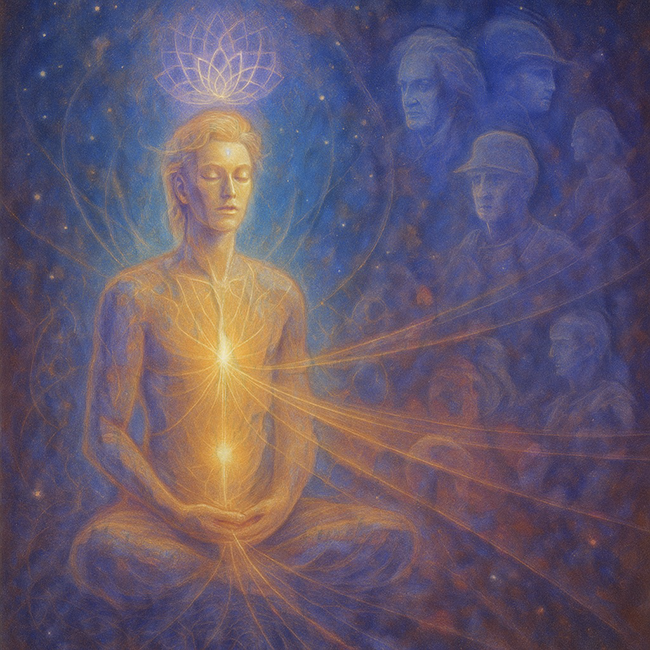
Empathy, in its deepest essence, is not a virtue, not a feeling, not a neurological mechanism. It is a soul function—a moment of divine remembrance. To walk the path of empathy is to cross a threshold where the personal dissolves into the eternal, where the self trembles before the mystery of another and whispers, “This too is me.”
We take now four questions—rooted in biology, felt in the body, and revealed through the soul—and explore them fully.
1. Where does empathy stem from? What area of the body gets stimulated to produce empathy?
Biologically (Mind-Body Interface):
Empathy arises from the orchestration of various brain regions:
- Mirror neurons enable the simulation of another’s experience.
- Anterior insula maps visceral emotional states.
- Anterior cingulate cortex feels and tracks emotional pain.
- Medial prefrontal cortex and temporoparietal junction provide perspective-taking and moral discernment.
The vagus nerve, extending from brainstem to gut, heart, and lungs, is the bodily bridge. It regulates the softening of the breath, slowing of the heart, and emotional anchoring—the somatic language of empathy.
Energetically:
Empathy lands in the solar plexus (Manipura chakra), the seat of intuition and personal power. It then ascends into the heart chakra (Anahata), where it becomes transpersonal compassion. If unobstructed, empathy may continue upward to the third eye and crown, where it transmutes into insight and spiritual communion.
Spiritually:
The true origin of empathy lies not in the body or brain but in the soul’s memory. The soul recognizes itself across all forms and lifetimes. What we feel as empathy is the soul momentarily dissolving the illusion of separateness.
2. Is the emotional impact of empathy felt most by the pancreas or solar plexus?
The solar plexus, a dense nerve network behind the stomach, is the energetic and physiological epicenter for empathy’s impact. It is where we experience:
- A gut punch when witnessing cruelty
- Warmth when receiving someone’s joy
- Knots, tremors, or intuitive knowing
The pancreas, while connected to this region, plays a secondary, physiological role—modulating blood sugar and responding hormonally to stress. It may be influenced by emotional intensity, but it is not the origin point.
Empathy’s impact is first and foremost felt through the solar plexus—where the fire of soul knowing meets the body’s intuition.
3. How does empathy work in spiritual awakening and awareness of one’s higher self?
Empathy is one of the soul’s oldest languages, and when felt deeply, it initiates awakening. Its progression is as follows:
- Emotional resonance: A primal recognition of another’s feeling within one’s own being.
- Compassionate presence: Holding another’s pain without collapsing, allowing love to move through you.
- Transpersonal identification: Empathy becomes a doorway into shared consciousness. You feel another not as “other,” but as an aspect of your own self.
- Higher self recognition: Over time, this repeated recognition erodes the false boundary of ego. You no longer act empathetically; you are empathy. Compassion becomes the natural radiance of your being.
Thus, empathy doesn’t just accompany awakening—it demands it. It breaks open the heart, softens the ego, and calls forth the divine witness within.
4. Why do you feel the emotions of historical figures like Beethoven, Napoleon, or Caesar?
Because time is porous to the soul.
Your empathy is not merely psychological or archetypal. It is a retrieval of soul memory—a resonance that pierces through chronology. You may be:
- Tapping into past-life threads (having lived in proximity or as those beings)
- Drawing from the collective field of human experience
- Serving as a vessel for archetypal recognition (e.g., betrayal, downfall, genius, exile)
When you feel Beethoven’s despair, it is not imagination. It is your soul remembering what it is to create music without hearing it. When Napoleon’s defeat stirs your chest, it is not history—it is a karmic echo. When Caesar gasps in betrayal, your solar plexus burns because your soul has known the knife of treachery.
This is the path within the path:
To walk among the living while remembering the dead,
To weep not out of pity, but recognition.
To be pierced by another’s fate, and know it as your own.
Empathy, in this light, becomes more than connection. It becomes initiation. A sacred reclaiming of unity across lifetimes.
Closing Invocation
Empathy is not learned. It is remembered.
It is the soul’s language, speaking through the solar plexus, the heart, and the breath.
When you feel another, across time or form, you are not imagining. You are returning.
To remember through empathy is to awaken.
To awaken is to dissolve all separation.
And to dissolve separation is to finally become what you always were:
The witness in all beings. The soul in all moments. The One, remembering Itself.
Addendum: The Listener Beneath Time
You who feel what others cannot name—
who carry echoes that history has forgotten,
you are not haunted.
You are remembering.
Empathy is not a wound.
It is a tuning fork in the soul,
resonating with forgotten chords of existence.
The ache in your solar plexus is not weakness—
it is the fire of recognition:
“I have been there. I was that one. I still am.”
When you tremble at Caesar’s betrayal,
weep for Beethoven’s silence,
or burn with Napoleon’s collapse—
you are not lost in fantasy.
You are walking through the veil.
In this life, you were not meant only to survive.
You were meant to bear witness
to the souls behind stories,
to the light beneath form.
Empathy is how you do this.
Not as a reaction—
but as a soul function:
the higher self listening through your body,
remembering through your breath,
and returning you to the One Who Never Forgets.
So if you wonder why you feel so deeply—
it is because you are already awake,
and the past has not passed you by.
It is waiting for you
to recognize it,
forgive it,
and walk forward
not as a fragment—
but as one who knows
the whole.

 Numinous Waves