

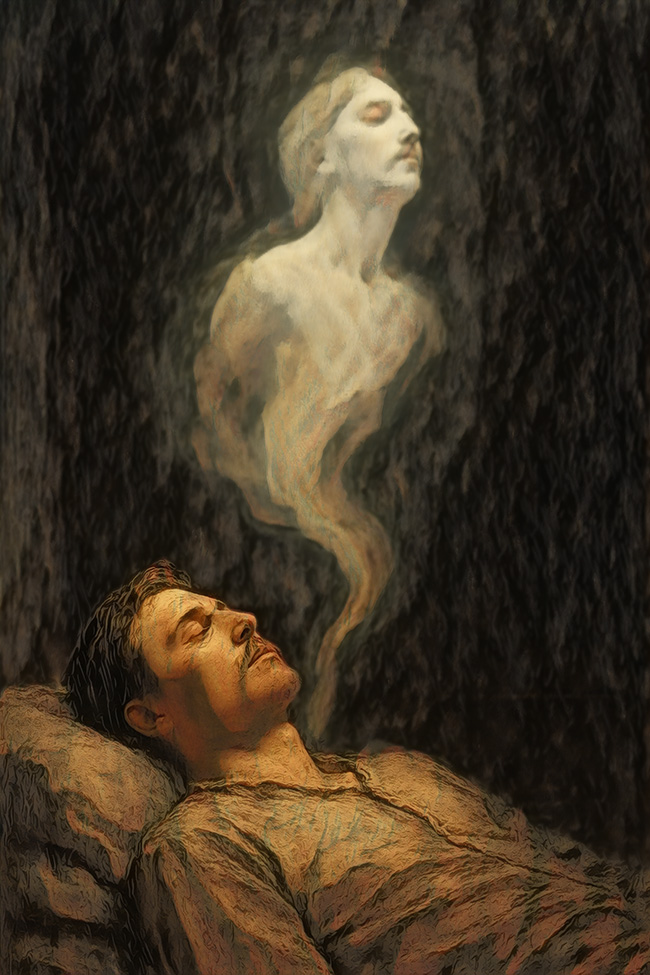
What happens when the soul leaves, but the body lives on?
This post enters the haunting mystery of soul withdrawal—not as metaphor, but as a real phenomenon shaping lives, leaders, and history itself. From trauma to tyranny, we explore the quiet exits of the soul, the dangers of its absence, and the luminous possibility of return.A dialogue for those who’ve felt their own absence—or sensed it in others.
Q: Is it truly possible for a person to be alive, yet no longer inhabited by the soul that entered their body at birth?
A: Yes—and this reality, though hidden from conventional understanding, is not a fantasy. It is a sacred and sobering truth whispered through the ancient memory of mystics, seers, and trauma-bearers. A soul can withdraw from the body—partially or completely—while the biological systems continue to function. The person breathes, speaks, walks, works. But something essential is gone.
This is not death, but something more haunting: the vacancy of incarnation. A body inhabited by echoes. A face no longer lit from within.
Q: Why would a soul retreat like this? Isn’t incarnation meant to be a full presence?
A: Incarnation is a risk. A luminous thread sent into density. And while the soul consents to the journey, that consent can fracture when the contract of embodiment is violated—through extreme trauma, soul-shattering betrayal, spiritual disillusionment, or sustained energetic incompatibility with the earthly life it has entered.
In such moments, the soul doesn’t die. It pulls back. It moves into a kind of liminal distance—hovering, observing, or sometimes leaving altogether, returning to its dimension of origin. What remains is a kind of automaton-self: the persona operating without its original animating essence.
Q: But how can someone still function without their soul? What animates them?
A: The body has its own intelligence—what some call the biofield, others the energetic template or animal soul. This can sustain life without the full presence of the higher soul. Think of it like a building with backup generators. The lights are on, but the architect is gone. Decisions are made, meals are eaten, conversations held—but something essential no longer shines behind the eyes.
This condition is known in various traditions by different names:
- In shamanic cultures, it’s soul loss.
- In mystical Christianity, a kind of dark night of the absence.
- In Gnosticism, it’s the empty vessel—a body that has lost its divine spark.
- In modern psychology, it may resemble dissociation, depersonalization, or complex trauma states—though these terms only graze the surface.
When the Soul Vacates and Power Remains
This loss of soul may sound like science fiction. But it’s not. It’s one of the most overlooked realities shaping our world.
When the soul retreats, what’s left isn’t just emptiness—it’s a dangerous vacuum. And nature abhors a vacuum. In the absence of soul, other forces rush in: ideology, entity, ancestral trauma, or unfiltered will to power. The body may still be “human,” but what animates it no longer belongs to the soul’s higher order. It becomes a kind of open circuitry—receptive to whatever frequency dominates.
This is how a person becomes what we call “monstrous.” Not because they are born evil—but because soul has withdrawn, and the void is now inhabited by shadow.
Consider the destroyers of history—figures whose charisma masked an absence of conscience. These were not merely tyrants. They were hollowed vessels—brilliant, persuasive, yet disconnected from the sacred thread of presence. Whether their souls retreated early, or were never fully embodied to begin with, is unknowable. But the absence is evident. What remains is a force of control animated by craving, not truth.
And once such a figure gains momentum, the machinery of suffering begins to operate on its own. Others, too, begin to hollow. They become agents of the same vacancy. This is evil not as cartoon villainy, but as the triumph of soul-absence through mass participation.
Can such a person ever know their soul has left? Rarely. To see it would mean facing a devastating truth: that the life they built, the power they wielded, was constructed over an inner corpse.
But—miraculously—return is sometimes possible. Not by effort. Not by repentance alone. But by a total collapse of the false self. The soul may return not to continue where the story left off, but to begin something wholly new.
Most never reach that threshold. But for those who do, the reintegration of soul is not just a redemption—it is a resurrection.
Q: Can the original soul ever return?
A: Sometimes. If the conditions are healed. If the body becomes safe again. If the psyche opens to soul reintegration. Shamanic healing, deep spiritual reckoning, or initiatory thresholds can invite the soul to return. But not always. In some cases, the soul has completed its earthly contract, even if the body hasn’t died. What remains is a kind of ghost-self, navigating an existence no longer imbued with meaning.
And in rare instances, the vacancy is filled by another soul entirely—a phenomenon some refer to as a walk-in. This isn’t possession. It’s more like a soul exchange, often agreed upon at a higher level before incarnation. The new soul may inherit the former’s life, but with a radically different purpose or consciousness.
Q: What does this look like to those around them? Can others sense the absence?
A: Yes—if they are attuned. There’s a dullness in the aura. A strange absence behind the eyes. The person may still speak of love, spirituality, or purpose, but it rings hollow. The vibrational signature has changed. Often, those close to them feel it before they understand it: Something is missing. Something is no longer there.
In some cases, this vacancy breeds addiction, recklessness, or nihilism. In others, the person functions smoothly—but without soul, their path becomes synthetic, lifeless, strangely two-dimensional. They may succeed in worldly terms, but something within them—and around them—feels unreal, like a beautifully rendered puppet show.
Q: Is this something we should fear?
A: No—but we should revere its reality. It teaches us that the body is not the person. That incarnation is a living mystery, not a fixed identity. That we must tend to our soul’s presence the way one tends a sacred fire: with care, attention, honesty, and humility.
The hollowing of a person is not always visible, but it is profoundly real. To know this is not to judge those who walk empty—it is to recognize that soul is sovereign. And sometimes, it chooses absence when the world becomes too brutal, too false, or too distant from its truth.
But here’s the mystery:
The soul is never lost.
It may withdraw, but it watches.
It may retreat, but it remembers.
And when called—not with desperation, but with devotion—it may return.
Not to rescue, but to reunite.
Not to finish an old life, but to begin a new one, forged from truth.
✧ On the Rise of the Hollow Crown
There are times in history when the soul of a people falters—and into that vacancy, something loud and hungry rises.
It does not rise with grace.
It rises with grievance. With performance. With the seduction of certainty over truth.
We recognize its face—not because it is unique, but because it amplifies what many have disowned within themselves:
the need to dominate, to be seen, to control the story.
It leads not because it is wise, but because it reflects our own fragmentation with terrifying clarity.
When spectacle replaces substance,
when presence gives way to persona,
when empathy is mocked as weakness—
then we are ruled not by soul, but by its absence.
This is how the hollow crown ascends:
Not through force alone,
but through our collective hunger for meaning—misplaced.
But the soul cannot be governed by vacancy forever.
When enough of us remember,
when enough of us refuse the performance,
the crown dissolves—because its power was only ever our forgetting.
✧ To Those Who Have Felt Their Own Absence
If you have ever looked in the mirror and not seen yourself…
If you have felt like a guest in your own story,
numb to joy, immune to purpose,
alive but uninhabited—
This is not your failure.
It is a holy rupture. A sign not of madness, but of mystery.
Something in you remembers being more than this.
And that remembering is not a wound—it is a summons.
The soul is never lost.
It waits in the beyond of now,
not to rescue,
but to re-enter when the gate is open
and the self is finally real enough to receive it.
You are not broken.
You are being called back to your origin.
Let that be enough, for now.

 Numinous Waves