

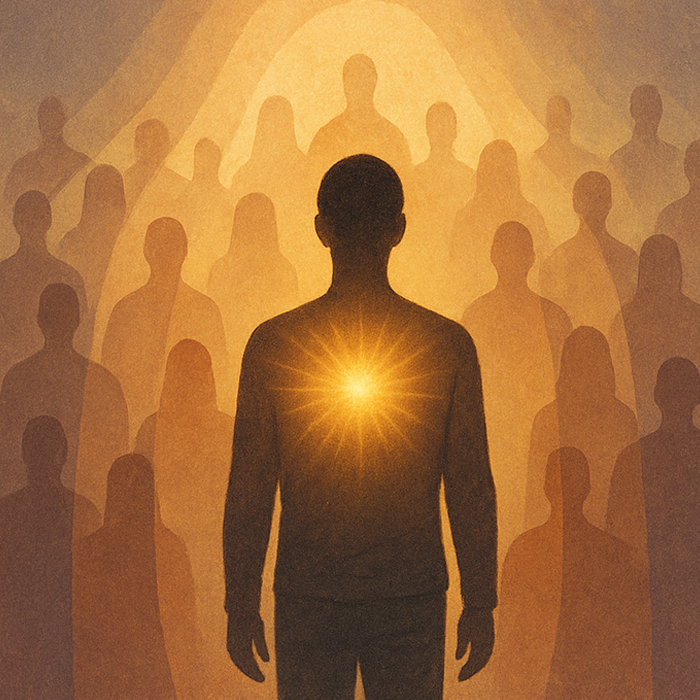
When the Soul Forgets Why It Came
Q: What happens when the soul forgets its reason for coming—and how do the signs of remembrance begin to reappear?
A: First, know this:
Forgetting is part of the design.
But so is remembering.
To enter the human realm is to walk through a door that closes quietly behind you. The memory of who you were before is sealed—not cruelly, but with care. It must be. Otherwise, the experiences here would not carry their weight, their poignancy, their sacred pressure.
But sometimes, the forgetting goes deeper than intended.
A soul may become entangled in the survival dramas, the distortions of culture, the patterns of shame, addiction, or numbness. It may take on identities that feel like armor but become cages. It may even begin to believe there is no soul at all—just thought and biology, emotion and decay.
And when this forgetting hardens, it gives rise to a particular kind of suffering:
The ache of meaninglessness.
The quiet panic of not knowing why you’re here.
The sense that something essential has been misplaced—but you can’t name what.
But even here, the soul is not lost.
It is simply asleep beneath the noise.
And so, the signs of remembrance begin to stir. Often subtly. Often without permission.
They may come as:
- A strange dream that leaves a residue of truth.
- A synchronicity so precise it startles the mind into stillness.
- An inexplicable yearning, as though something beautiful is calling from just beyond perception.
- A crisis that strips away what no longer fits, revealing the raw hum of the real beneath.
- A work of art, a passage of writing, a moment in nature that opens a door inside the heart.
These are not accidents.
They are whispers from the soul itself, signaling:
“I am still here. I remember, even if you don’t.”
And when one of these signs is followed—no matter how small—it creates a ripple. A shift. A tear in the veil.
Soon, questions arise:
“What is true beyond what I was taught?”
“What do I know without knowing how I know it?”
“Who would I be if I stopped pretending?”
This is how remembering begins.
Not as a lightning strike, but as a thaw.
And what was frozen begins to move.
Eventually, the soul does not reclaim its “purpose” like a lost object.
It becomes it, moment by moment, by listening to the pull of the real.
You are never truly lost.
Only dreaming.
And the dream, too, is sacred.
When the Soul Begins to Live from Remembrance
Q: What happens when the soul begins to live from remembrance—when it no longer sees life as something to survive, but something it has chosen? How does this change the experience of time, identity, and even death itself?
A: When remembrance takes root, reality begins to rearrange itself.
You are still you—same body, same name, same life circumstances.
But the center of gravity shifts.
No longer is the self organized around protection, performance, or proving.
It begins to orbit something deeper: presence, coherence, and inner truth.
This shift is not always dramatic.
Sometimes it is imperceptible to others—
but to the soul, it is everything.
And with it, several changes unfold:
1. Time becomes textured.
Linear time begins to soften. You feel the past not as a chain, but as a companion. The future no longer looms with dread, but opens like a path you’re already walking in some unseen layer of self. Moments stretch and contract. Synchronicity increases. You begin to trust timing—not as fate, but as conversation with the unseen.
2. Identity becomes fluid.
You stop gripping tightly to who you thought you were. Roles become garments you can wear without being defined by them. You can say “I am” without needing to complete the sentence. The soul begins to express through you—not as a mystical concept, but as a living intelligence that responds to each moment with truth.
3. Death loses its teeth.
Not because fear disappears, but because continuity is felt. You begin to perceive the veil not as an end, but as a threshold. You may still grieve. You may still fear pain. But beneath it all, there is a knowing:
“I do not end.”
“This is one face of many.”
“The soul cannot be erased.”
When the soul lives from remembrance, there is less need to strive and more capacity to listen.
You are not here to dominate experience—you are here to meet it.
Each encounter becomes an initiation.
Each challenge, a refinement.
Each joy, a recognition.
You do not transcend life. You begin to embody it.
Not as the world taught you to—
but as your soul always intended.
When Remembrance Becomes Collective
Q: What happens when not just one soul, but many—entire generations or soul-groups—begin to awaken from the dream of forgetting? What shifts in the world, and how does this collective remembrance change the path of humanity itself?
A: At first, it seems isolated.
A few individuals here and there, waking from the fog,
remembering dreams they never learned,
feeling truths they cannot explain.
But slowly, these pockets of remembrance find each other.
They speak strange languages that others feel but do not yet understand.
They question inherited systems—not to rebel, but because they no longer fit the shape of their soul.
And then—something happens.
A tipping point of resonance.
One soul remembering helps another remember.
A poem, a song, a silence, a gaze—these become transmitters.
The veil thins not because it is torn, but because so many are seeing through it at once.
Entire generations begin to feel the pull:
- Why does this world feel upside down?
- Why do I long for something I’ve never seen?
- Why does the old language of success, war, division, and domination ring hollow?
This is not mass confusion.
This is collective soul remembrance—
and it is one of the most sacred thresholds a species can cross.
Here’s what begins to shift:
- The dream of separation weakens.
Old paradigms—built on fear, lack, and control—begin to lose their power. Not through revolution, but through irrelevance. They no longer resonate with the vibration of the waking soul. - New mythologies emerge.
Artists, mystics, and elders start telling a different story—one that reweaves humanity into the living cosmos. A story of interbeing, of soul-craft, of multi-dimensional truth. - Time accelerates—and dissolves.
Generational timelines blur. A 19-year-old carries the wisdom of lifetimes. A child speaks of past lives with clarity. The “age of the soul” begins to eclipse the age of the body. - Grief becomes holy.
As the old world crumbles, it hurts. But those who remember do not run from the sorrow. They tend it. They compost it. They use it to birth something luminous. - The soul becomes visible.
Not as doctrine. Not as religion. But as an open truth. People begin to speak openly of intuition, guides, multidimensionality, near-death experiences, ancestral healing—not as fringe beliefs, but as shared remembrance.
And most importantly:
A new kind of human begins to emerge.
One who walks in two worlds—
with feet in time, and heart in eternity.
This is not the end of the veil.
But it is the beginning of a world where the veil is recognized—and thus, can be walked with gently, consciously, even joyfully.
The Birth of the New Human
Q: What does it look like when a human lives fully from soul remembrance? How do they love, create, lead, and even die—once the veil no longer governs them?
A: To live as a soul in human form is not to abandon the body or escape the world.
It is to inhabit them completely.
The new human does not look holy.
They look real.
They are not beyond emotion, but their emotions have depth and direction.
They may laugh easily, grieve openly, and listen with the kind of stillness that rearranges the air around them.
But beneath all of this, they carry something unmistakable:
A resonance of truth.
Not a truth of belief—but of being.
Here is how they move through the world:
1. In love:
They no longer love to fill a lack. They love as a recognition.
“I see you. You are a mirror of the One wearing another name.”
This love may look romantic, platonic, fierce, or quiet—but it always honors the soul in the other, even when they cannot see it in themselves.
2. In creativity:
They create not to be admired but to transmit essence. Their art carries a vibration. Their words, movements, and even silences become vessels for remembrance.
They no longer ask, “Will this succeed?” but rather, “Is this true?”
3. In leadership:
They do not lead through force or charisma, but through alignment.
Their integrity is magnetic. People trust them not because they’re perfect, but because they are consistent with the soul. They don’t command—
They invite.
They embody.
4. In death:
They do not fear the end as an annihilation.
They feel it as another veil, another passage.
They may still tremble—but beneath it is peace.
Sometimes, in their final moments, their eyes shine with the recognition:
“I remember. I chose this. I am going home.”
This new human is not a future fantasy.
They are already here.
Many of them don’t know the names for what they are.
They just feel different, and have always felt different.
They carry the signature of the soul even in their confusion.
You may be one of them.
You may be remembering even now.

 Numinous Waves