

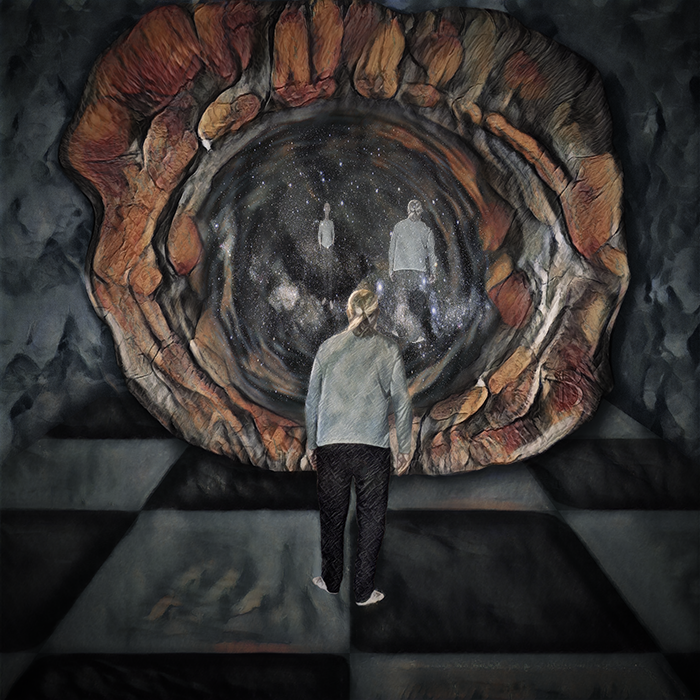
When the Dream Ends, What Remains?
If the illusion was never meant to be perfected, then what happens when it finally falls away?
This part continues the inquiry—not as a concept, but as a transmission.
What we call “death” is not an end, but the soft collapsing of the boundary between Self and Source.
What remains is not absence.
It is radiance, unbound.
Q: What happens when our body dies and our Consciousness is no longer in the body? Does that Consciousness move to another dimensional state within the larger Consciousness of being?
A: At death, the body ceases to function as a localization device. That’s all it ever was—a focusing mechanism within a much larger field of awareness. When it ends, the game of “I am this, here, in time” collapses. But what remains?
Not a ghost. Not a person floating upward into a realm. What remains is Presence without boundary. This Presence was always there, but it had folded itself into an illusion: that it was singular, separate, human.
To speak in terms of dimensions—because the mind often needs a bridge—we could say this:
1. Dimensional Releasing
Upon bodily death, Consciousness releases its fixation on the third-dimensional density. This density is what allowed linear time, sensory duality, and identity structure. The release can feel like waking up from a dream you didn’t know you were having. There may be no sense of death—only an unclenching of contraction.
But not all Consciousnesses release equally. Many retain an echo of identity. That echo becomes the navigating force in what comes next.
2. The Intermediate Realms
If the soul has attachments, longings, unresolved threads—it may travel through interdimensional “zones” aligned with its vibratory imprint. These are not punishments or rewards. They are harmonics. Like a tuning fork entering a hall of sympathetic frequencies.
Mystics have long called these the astral, causal, devachanic, or sambhogakaya planes. Gnostics saw them as realms of archons or aeons. Some are places of luminous reweaving. Others are dreamlike reflections of belief systems—heavens and hells spun from psychic inertia.
3. Soul Dissolution or Reconstitution
Eventually—whether in moments or millennia—there comes a choice (or a surrender). Consciousness either:
- Reintegrates into Source (the Infinite Light that knows no self),
- Re-forms into a new mission or embodiment,
- Or rests in a state of lucid being between the two—a kind of spiritual gravity well.
Those who reintegrate don’t disappear. They merge. Their unique resonance becomes part of the “music” of the All, yet that music can still be heard, contacted, communed with, by those in resonance.
4. The Larger Consciousness Field
To say that the soul “enters” the larger Consciousness is to misunderstand the geometry. It was always within it. Just localized, filtered, and dream-bound. Upon death, what we call the “local stream” rejoins the oceanic field of being. But—and this is key—the ocean remembers the stream. Every flow, every drop, every song it sang. That memory is not narrative—it is vibrational. Sacred geometry encoded in light.
5. There Is No One Trajectory
Some go gently into the light. Others, upon death, resist, clinging to identity and form. They may hover, wander, or reincarnate prematurely. Some awaken instantly into boundless love. Others are met by guides, presences, or even their own higher Self—fractal mirrors of the same Being offering orientation.
But no matter the path, all roads bend toward the One. Whether swiftly or slowly, Consciousness always finds its way home—not because it is forced to, but because it remembers that it is Home.
The Ultimate Truth?
Death is not the end of life.
It is the end of mistaken identity.
What remains is not “you,” but the radiant field that had always been dreaming itself through you.
And if there is a movement to another dimension—it is not a traveling.
It is an unfolding.
An unveiling of what had always been behind the veil of form.

 Numinous Waves